
Scroll your feed and you'll find two camps: "AI will take all design jobs," or "AI is just a tool, don't worry." Both are lazy.
What's happening on real teams in 2026 is more uncomfortable and more useful than either of those takes.
This post has been updated twice: first when Claude Design launched in April 2026, and again now. On June 17, Anthropic shipped a major Claude Design overhaul: design system imports, bidirectional Claude Code integration, and nine new export destinations. Meanwhile, Figma's State of the Designer 2026 report updated the adoption numbers in this post significantly. Both changes are reflected here. You can read my full take on Claude Design in my latest article.
The numbers that should end the panic
Start with adoption. The numbers moved fast.
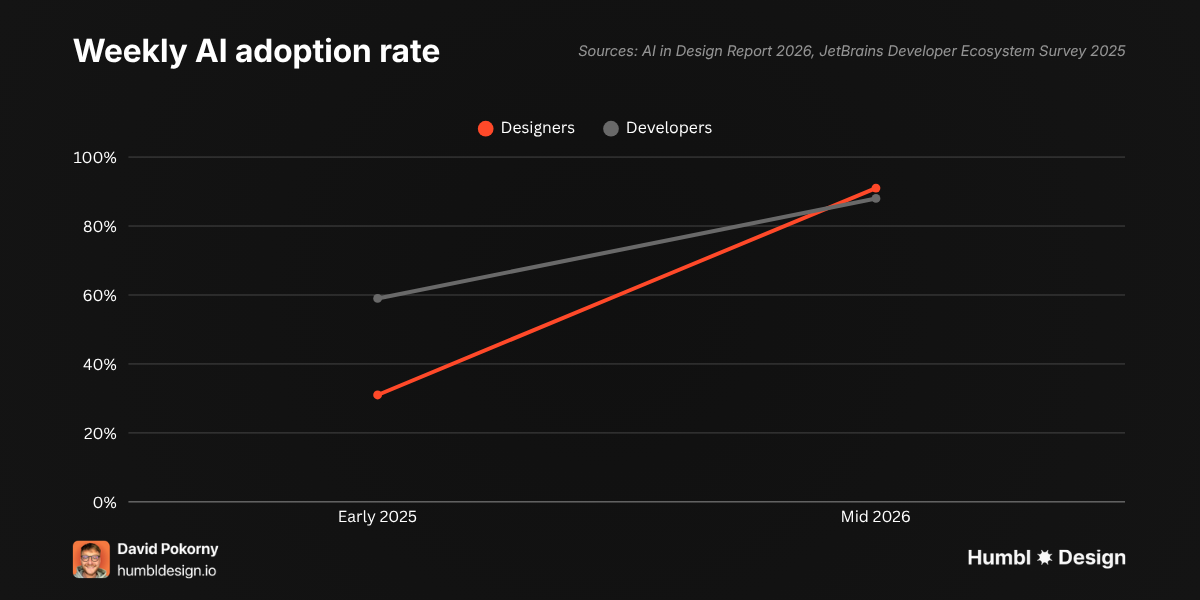
The AI in Design Report 2026 (900+ designers surveyed, interviews with leaders at Anthropic, Stripe, Cursor, and DoorDash) found 91% of designers now use AI weekly. Three quarters use it daily. Figma's State of the Designer 2026 (906 designers across 5 regions) found 72% use generative AI, with 98% increasing usage year over year. Developer adoption sits at 85-90% across JetBrains and Stack Overflow surveys. (Sources at the bottom.)
The adoption gap from a year ago is closed. The quality gap has closed too:
That last row is the one people miss. Designers are now more intense daily AI users than developers. Designers who lean into AI are also 25% more likely to report growing job satisfaction than those who aren't (Figma 2026).
The conversation about whether designers would adopt AI is settled. What they do with it is the only question left.
Once you look at what each tool has to produce, the code vs. design divide still holds. Code has to compile and pass tests, a narrow definition of "correct." A design has to understand why users bail at step two of checkout on mobile, or what the founder's actual fear is when they say "this feels corporate." AI doesn't clear that bar yet.
Now look at jobs. Traditional graphic design roles grow 2-3% through 2034. UX, UI, and product design roles are projected to grow 7-8% in the same window (BLS groups them with web developers). The official BLS number is the floor. The on-the-ground picture is sharper: 82% of design leaders say their org's need for designers has increased or stayed the same (Figma 2026), with many reporting 10-25% active growth in headcount demand. Global picture by 2030: 170M new roles created, 92M displaced, net +78M (WEF Future of Jobs 2025). The split is already visible.
On money: workers with AI skills earn 56% more than peers without them (PwC 2025 Global AI Jobs Barometer). Design managers and leads inside AI-augmented teams are commanding $160K-$190K.
Companies building AI products are hiring design skills alongside engineering. Turning a model into something people actually want to use is a design problem, not just a technical one.
The 60% problem
Working with AI on real client work, the pattern is always the same.
AI gets you 60% of the way in minutes. Layout ideas in seconds. 20 hero section variants before lunch. Palette and type pairings that are good enough to use. Early on, it feels like magic.
Then you hit the wall.
The layout is clean but doesn't fit the brand. The copy is technically fine but doesn't match how the founder actually talks. The flow follows "best practices" but ignores how users in this particular product behave.
That missing 40% is where design actually lives. Knowing this FinTech audience won't trust a playful illustration because you shipped one in 2023 and watched bounce rates jump. Knowing this checkout pattern kills B2B conversion because you tested it twice and both times the drop was in step two. Knowing this founder will kill anything that looks like his last employer. Not because he said so, but because you've watched him in review meetings.
Designers walk in with that memory. AI walks in with the internet.
What happens after the first pass is the real job
Experience in design is watching real users get stuck in onboarding across ten different products. Shipping a pricing page that flops and then figuring out exactly why. Redesigning the same flow three times for three companies, each with different constraints. Hearing "make it pop" a hundred times and eventually knowing what each client means by it.
That accumulation becomes pattern recognition. You can tell when "let's add more features above the fold" is a founder panic move dressed up as strategy. You can tell which "clean, minimal" layouts quietly kill conversion in the wild. You can tell when a brand is lying to itself about who they are, and the UI needs to stop reinforcing the lie.
None of that pattern recognition is downloadable.
Where this matters most is the feedback loop. Nothing in design takes longer or pays better than walking a client through rounds of reactions, and AI has no grip on it.
The client says: "We want something modern, premium, but still friendly. Also different from everyone else."
You translate that into three directions. One leans premium. One leans friendly. One pushes them into territory they said they didn't want. They react. Their reactions are inconsistent. They love one thing in Direction A and hate a similar thing in Direction B. What they respond to tells you ten times more than the brief did.
Over a few rounds, you figure out their real taste, where they're brave and where they're conservative, and what "premium but friendly" actually means for this team, this product, this stage of the company.
AI will happily generate "modern, premium, friendly" layouts all day. What it can't do is notice that every time you push too far on minimalism, the founder tenses up. Or that the client-side designer is scared of shipping something that might get them blamed later. Or that the CEO keeps saying "trust" while pointing at things that are actually about status.
Making screens is the easy half of the job. The hard half is getting a room of humans to agree on a direction that actually works. That part is still very much alive.
Everything AI ships looks the same
Scroll any "AI redesigned my dashboard" thread on X and you'll see it. Rounded cards. Soft shadows. Neutral grays. Indigo or purple accents. Two-column layouts with familiar spacing. Technically responsive. Technically accessible. Technically modern.
And technically indistinguishable from every other AI dashboard posted that week.
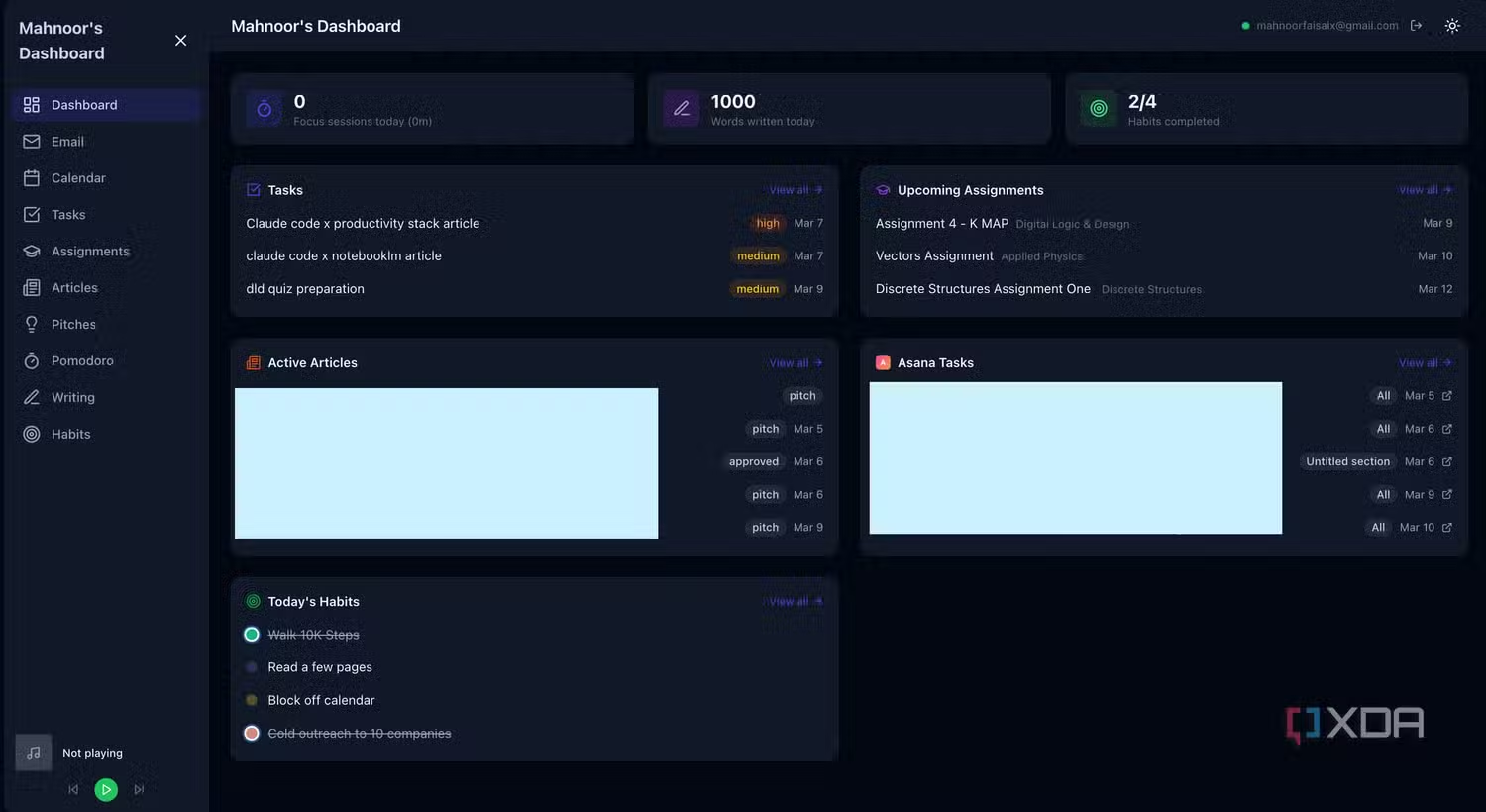
The quiet cost of AI-first design is convergence toward the same safe average. It's what happens when your only training signal is "what did successful sites do last year." You get the median. You never get above it.
A real designer can take the same component library and produce five distinct moods. Violate the default spacing system when the brand's energy calls for it. Strip things down to earn trust, or turn them up to earn excitement. Pick the exact weight of a typeface that makes a scrappy SaaS feel grown up without feeling corporate. None of that comes from a prompt.
People underestimate how hard consistent visual style actually is. A mature design language isn't "big sans-serif and lots of white space." It's the precise relationships between sizes, weights, and letter-spacing. A rhythm in spacing that gives the product its breathing pattern. A signature way shadows and dividers get handled. A system for how illustration, photography, and UI live together without fighting.
AI struggles with every piece of that. Matching a particular style at fidelity. Holding that style across 40 screens without drift. Blending two or three influences into something coherent rather than mush.
Designers can build style systems from scratch, decide which rules are sacred and which can bend, and look at a screen and say "this element doesn't belong in this universe." None of that is shortcut-able by prompting.
The job title is splitting in two
Underneath the noise, something simple is happening. "Designer" is quietly becoming two different jobs.
Bucket one: designers who push pixels from tickets.
- Rarely talk to users or stakeholders
- Don't own outcomes, just tasks
- Comfortable being told exactly what to make
- Work mostly from briefs someone else wrote
This is the bucket AI is squeezing hard.
Bucket two: designer-strategists.
- Define the problem before drawing anything
- Talk to founders, PMs, users, and engineers directly
- Care about revenue, retention, and trust, not just polish
- Use AI constantly, but as a tool to go faster, never as a crutch to think
This bucket is getting more valuable every quarter.
Most of the panic-posting on X about AI killing design is written by people in bucket one who feel the squeeze and assume everyone else is about to feel it too.
Claude Design is the clearest signal yet
Anthropic launched Claude Design on April 17, 2026, a fresh example of the split above. The way Anthropic frames it in the announcement tells you a lot: "Claude Design gives designers room to explore widely and everyone else a way to produce visual work."
Two different promises for two different audiences. Designers get a wider exploration budget. They can prototype a dozen directions instead of the two or three they usually have time for. Non-designers (founders, PMs, marketers) get a way to produce polished visual work without hiring or waiting for one.
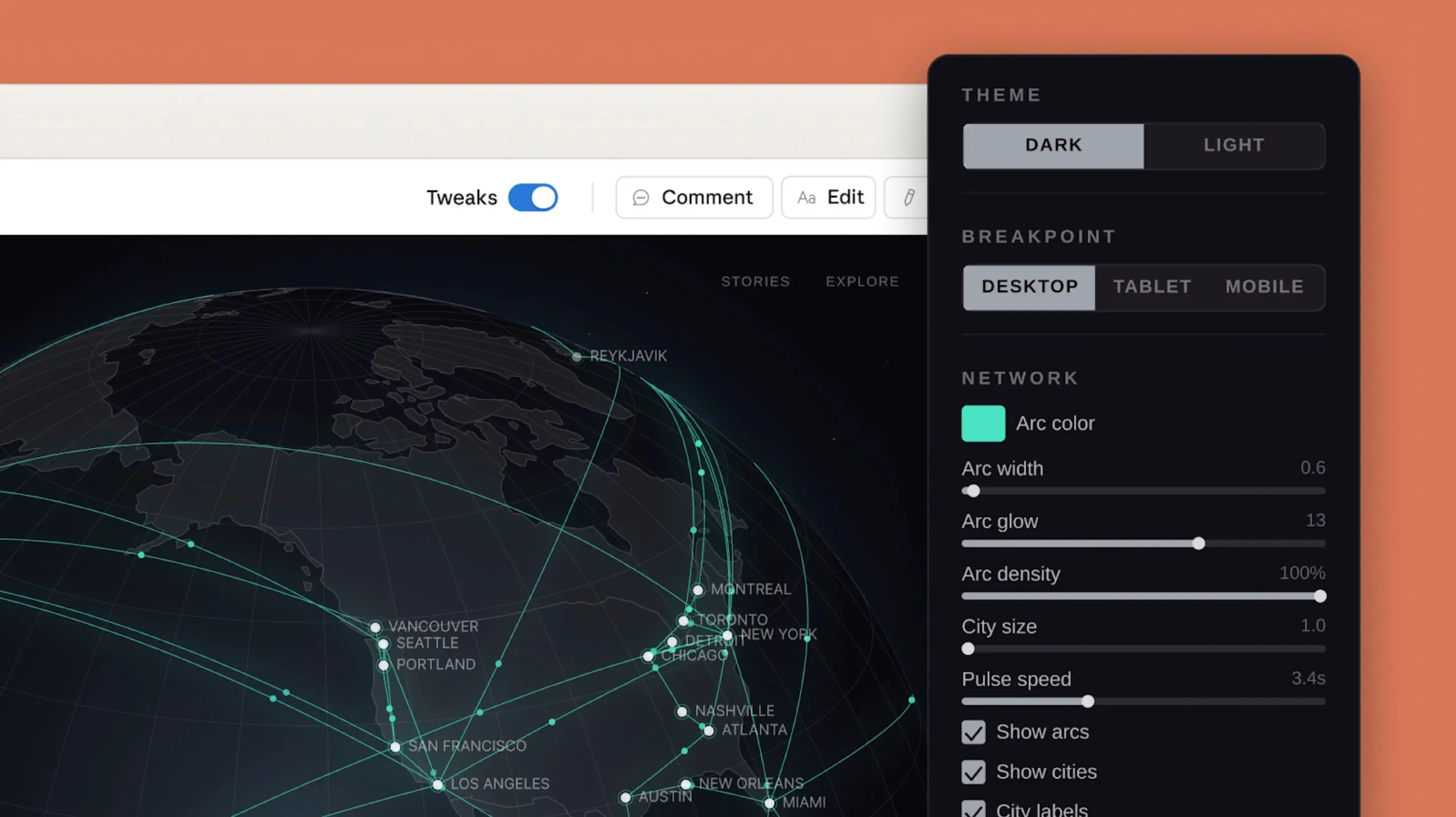
The workflow, at a glance:
- Describe what you want. Claude generates a first version on the canvas.
- Refine through chat, inline comments, direct edits, or custom sliders Claude builds for your specific design.
- Bring in your design system from a GitHub repo, design files, or raw uploads. Claude builds with your components and auto-corrects against the system before you see it.
- Export to Canva, PDF, PPTX, or standalone HTML, with direct integrations to Adobe, Miro, Replit, Lovable, Vercel, Wix, and Gamma. The Claude Code handoff now works both directions: hand off a design to Claude Code, or use
/designin the terminal to create and edit projects without leaving the command line.
The two customer quotes on the launch page tell the honest story:
Olivia Xu, a senior product designer at Brilliant, says pages that took 20+ prompts in other AI tools took 2 prompts in Claude Design, and the Claude Code handoff was clean. That's a strategist-designer getting a speed boost on the volume part of the job.
Aneesh Kethini, a PM at Datadog, says they now go from rough idea to working prototype before anyone leaves the room. The non-designer use case, working exactly as promised.
Both quotes land on the same truth. Claude Design speeds up what designers already do, and lets non-designers produce what they couldn't before. It stays out of the part of the job where taste, strategy, and client relationships live.
Two months in, Anthropic shipped a major overhaul on June 17. The previous version lacked consistency when applying design systems across prototypes. The new version checks every output against your system and auto-corrects before you see it. Enterprise admins can now lock down one approved design system org-wide. Over a million people used Claude Design in its first week. Anthropic designer Nate Parrott told Fast Company the goal is clear: "It's much more about how can we stake our claim to the beginning of the design process, rather than the end."
My bet: Claude Design will do to throwaway internal visuals what Canva did to stock graphics. It'll eat a lot of the "I need a pitch deck slide by Tuesday" or "can you whip up a landing page mockup" work that used to clog junior designer calendars. It won't touch the deeper work. Brand direction, systems thinking, the back-and-forth with clients where real design decisions get made. You can read more in depth in my recent article.
One thing worth tracking. Claude Design runs on Claude Opus 4.7, Anthropic's most capable vision model for design, and the ceiling will keep rising. You want to be in the position where a rising ceiling just means better first drafts for you to work from. The actual job stays yours.
What to hand off to AI without guilt
Avoiding AI entirely costs more than people admit. Not in productivity numbers, in taste calibration. You lose your read on what AI can and can't do, and that read is a required skill now.
Let AI handle the volume work:
- First-pass layout ideas to react to, not accept
- 20 hero section variants before you commit to one
- Stakeholder notes and email threads turned into a working brief
- Hand-drawn wireframes promoted to something presentable
- The asset resizing that used to eat Thursday afternoons
None of that is the craft. It's the noise around the craft.
What moves your career in 2026
Four things. Not ranked. All compounding.
Get loud at problem definition. Turn vague business requests into sharp, fightable design problems. This is the skill founders and PMs will pay a premium for, because most designers skip it and jump straight to solutions.
Practice feedback alchemy. Translate "I don't like it" into a real signal. Most client feedback is symptoms, not diagnoses. Reading past the surface words is half your job.
Train your eye like it's a muscle. Curate references obsessively. Build a personal library of "this works because..." notes with actual reasons attached, not just screenshots in a Figma file. AI has averaged taste. Yours shouldn't.
Get fluent with AI. Know exactly where it makes you faster. Know exactly where it makes the work worse. Having that map is more valuable than loving or hating the tools.
Summary
AI won't replace designers. It will replace template jockeys. People whose only differentiator is "I can make it look clean," who take tickets, push pixels, and never talk to a user.
For everyone else, AI feels less like a threat and more like hiring a very fast, very junior assistant. Great at volume. Terrible at nuance. Needs constant direction. Can't be left alone with a real client.
This pattern isn't new. The design industry has been doing exactly this for years with interns, juniors, and offshore production teams. We didn't fire senior designers when we hired juniors. We changed what seniors worked on. AI is the same story at a different scale.
The second-order effect is the thing the market hasn't priced in yet. The internet is about to fill with AI-generated landing pages, logos, and dashboards that all feel like the same SaaS template. Same rounded cards. Same gradients. Same "vibe." When average becomes free, anything with a real point of view becomes disproportionately valuable.
Brands that don't look like anyone else. Products whose UX clearly wasn't assembled from parts. Visual languages you recognize without the logo. Experiences that feel like a relationship, not a transaction.
If your work lives in that space, 2026 will be the best year of your career.
Data sources
Figma - State of the Designer 2026 - https://www.figma.com/reports/state-of-the-designer-2026/
Figma - Why demand for designers is on the rise (Feb 2026) - https://www.figma.com/blog/why-demand-for-designers-is-on-the-rise/
Designer Fund / Foundation Capital - AI in Design Report 2026 - https://stateofaidesign.com/
Anthropic - Claude Design June 2026 update - https://claude.com/blog/claude-design-stays-on-brand-for-daily-work
Bureau of Labor Statistics - Web Developers and Digital Designers Occupational Outlook - https://www.bls.gov/ooh/computer-and-information-technology/web-developers.htm
Bureau of Labor Statistics - Graphic Designers Occupational Outlook - https://www.bls.gov/ooh/arts-and-design/graphic-designers.htm
PwC - 2025 Global AI Jobs Barometer - https://www.pwc.com/gx/en/issues/artificial-intelligence/ai-jobs-barometer.html
WEF - Future of Jobs Report 2025 - https://www.weforum.org/press/2025/01/future-of-jobs-report-2025/
JetBrains - Developer Ecosystem Survey 2025 - https://www.jetbrains.com/lp/devecosystem-2025/
Noble Desktop - Future Growth (Digital Designers) - https://www.nobledesktop.com/careers/designer/job-outlook
Gloat - 10 Key AI Workforce Trends In 2026 - https://gloat.com/blog/ai-workforce-trends/
PwC - The Fearless Future: 2025 Global AI Jobs Barometer - https://www.pwc.com/gx/en/services/ai/ai-jobs-barometer.html
Refonte Learning - UI/UX Design Salary Guide 2026 - https://www.refontelearning.com/salary-guide/ui-ux-design-salary-guide-2026
Autodesk - AI Job Growth in Design and Make: 2025 Report - https://adsknews.autodesk.com/en/news/ai-jobs-report/
Any statistics cited in this post come from third‑party studies and industry reports conducted under their own methodologies. They are intended to be directional, not guarantees of performance. Real outcomes will depend on your specific market and execution.
Will AI replace designers in 2026?
No. 91% of designers now use AI weekly (AI in Design Report 2026), and UX/product design roles are projected to grow 7-8% through 2034 (BLS). 82% of design leaders report their org's need for designers has increased or stayed the same. AI handles volume and first-pass exploration. The research, strategy, and feedback interpretation that make UX valuable: that work hasn't moved.
How many designers use AI right now?
91% use AI weekly, according to the AI in Design Report 2026 (900+ designers, Designer Fund and Foundation Capital). Figma's State of the Designer 2026 (906 designers) puts generative AI adoption at 72%, with 98% increasing usage year over year. Three quarters of designers use AI daily, more frequently than developers (51%). Adoption is settled. What designers do with the tools is the only open question.
What is Claude Design and how does it affect the design industry?
Claude Design is Anthropic's AI design tool, launched April 17, 2026. It lets designers prototype many more directions than deadlines usually allow, and lets non-designers (founders, PMs, marketers) produce polished visual work without a design background. The June 17, 2026 update added design system imports, bidirectional Claude Code integration, and expanded exports to nine platforms including Adobe, Miro, Replit, Lovable, Vercel, and Wix.
Do designers with AI skills earn more?
Yes. Workers with AI skills earn 56% more than peers without them, according to PwC's 2025 Global AI Jobs Barometer. Design managers and leads inside AI-augmented teams are commanding $160K-$190K. The premium is real and widening.
What design skills matter most as AI improves?
Problem definition, feedback interpretation, and visual brand strategy. These are the skills AI can't simulate: turning a vague client request into a specific design problem, reading inconsistent feedback across rounds to find what clients actually respond to, and building design systems with a distinctive point of view that holds across 40+ screens. Speed and output volume are commoditized. Judgment isn't.