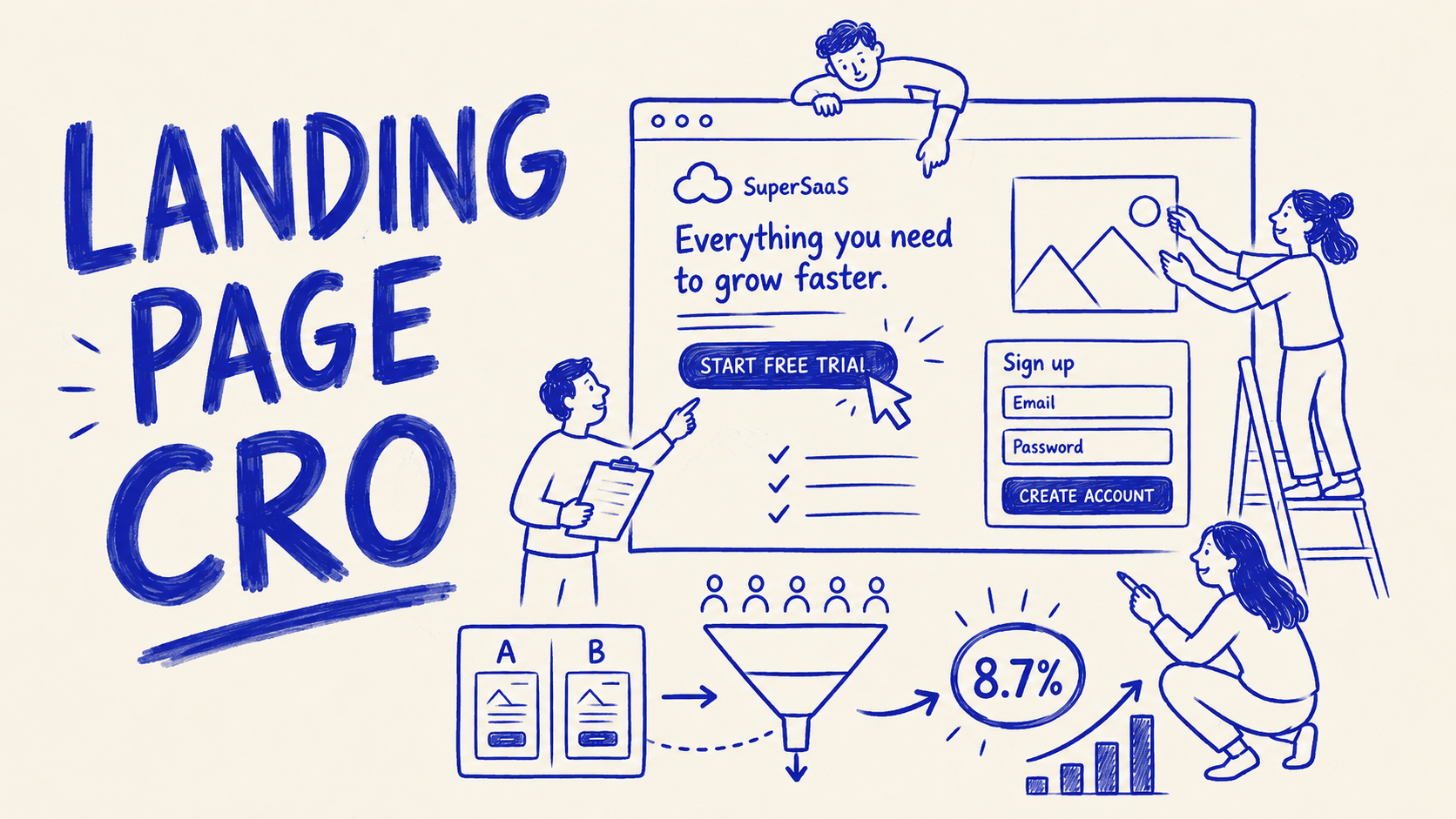
After 50+ landing page audits, I've learned that the benchmark question is almost always the wrong starting point. But it's also unavoidable. Founders ask it. Designers should know how to answer it.
So here's what the 2026 data actually says about SaaS landing page conversion rates, why the headline number is less useful than you think, and what actually moves it.
The SaaS landing page conversion rate benchmarks
The most comprehensive dataset available is Unbounce's Q4 2024 analysis of 464 million visits across 41,000 landing pages. The numbers are useful. The context around them is more useful.
Median landing page conversion rate across all industries: 6.6%.
SaaS and technology: 3.8%. The lowest of any tracked industry.
Top performers in any industry: 10–15% or higher.
For comparison: events and entertainment sits at 12.3% median. Financial services at 8.4%. SaaS founders sending paid traffic to a 3% converting page can feel like they're failing when they're roughly at benchmark for their industry.
Source: Unbounce Q4 2024 Conversion Benchmark Report
SaaS is low for a reason. The consideration cycle is long. The conversion action is usually a signup or demo request, not a simple form fill. The visitor needs to understand a product before they hand over their email. That takes copy, hierarchy, and trust signals working together.
Why the blended number is almost useless
Here's the problem with a number like 3.8%. It's a blended average across every SaaS landing page, every traffic source, every type of conversion action.
B2B SaaS breaks down very differently by page type, according to Daydream's 2026 benchmark data across companies doing $5M-$50M ARR:
A 3% conversion rate on a demo request page for a $500/month B2B SaaS is solid. A 3% rate on a self-serve trial page where the ask is just an email address is a problem.
Traffic source changes things even more dramatically. From Foundry CRO's 2026 benchmarks:
- Direct traffic converts at around 3.3%
- Paid search averages 3.2%
- Organic search averages 2.7%
- Social media averages 1.5%
A 3% blended rate could be a 5% paid search rate dragged down by 1.5% social traffic. That tells a completely different story than a flat 3% across all sources. One is a traffic mix problem. The other is a page problem. They need different fixes.
The 3 things that actually drive SaaS conversion rate
Here's what most designers miss when they look at conversion rate data. The page itself is only one variable. There are 3:
1. Traffic quality
High-intent branded search traffic converts at 5–10% regardless of page quality because the visitor already knows what they want. Cold social traffic converts at 1-3% even on an excellent page because the visitor isn't ready to act.
If a founder is sending cold social traffic to their main landing page and getting 2% conversion, a redesign won't fix it. Better targeting will. Understanding this keeps you from taking on blame that doesn't belong to the design.
2. Message match
This is the biggest conversion lever most designers never touch. Message match is whether the page reflects the specific promise of the ad or source that sent the visitor.
A visitor who clicked "save 40% this quarter" and lands on a page about enterprise features has already lost trust before they read a word. The Foundry CRO data shows email visitors convert 77% more when the landing page was built specifically for that email campaign. Same traffic. Different page. 77% more conversions.
Designers rarely ask: "what ad or source is sending people here, and does this page match that expectation?" They should. It's the question that separates pixel-pushers from conversion designers.
3. Offer relevance
The conversion action needs to match where the visitor is in their decision process. Asking a cold visitor to book a 30-minute demo is a big ask. Asking them for an email in exchange for something useful is lower friction.
I see this constantly in audits: founders with a single CTA that's a demo request on every page, regardless of the visitor's intent. The data supports reducing friction. Single CTA pages convert at 13.5% vs 10.5% for multi-CTA pages according to Unbounce's data. The issue is asking for too much too soon from the wrong visitor.
What moves the needle
Assuming traffic quality and message match are solid, design does the heavy lifting. Here's where it actually shows up in the numbers.
Social proof placement
Moving a testimonial adjacent to the primary CTA produces a 68% conversion lift in documented tests. Not redesigning the testimonial section. Just moving it next to the button.
Most SaaS landing pages bury social proof at the bottom or in a dedicated section halfway down the page. The visitor hasn't made a decision yet. They need reassurance at the moment of commitment, not after they've scrolled past it.
Single CTA hierarchy
Every extra CTA competes for attention. Multiple calls to action create decision paralysis. The 13.5% vs 10.5% conversion difference between single-CTA and multi-CTA pages isn't an accident. When a visitor doesn't know what to do next, they do nothing.
This shows up most on hero sections where founders add "Start for free," "Book a demo," and "Watch a video" side by side. Pick one. Make it obvious. Let everything else on the page support that single action.
Above-the-fold value clarity
From the diagnostic frameworks I've seen consistently hold up across 50+ audits: if a visitor can't understand what the product does, who it's for, and why it matters in under 10 seconds, the rest of the page is wasted.
The hero section needs to answer three questions: what is this, who is it for, and why should I keep reading? Most SaaS heroes answer the first question and skip the other two.
Mobile layout
Mobile conversion rate runs roughly 40% lower than desktop across most B2B SaaS pages. Founders share their URLs on Slack and WhatsApp. Most of those clicks happen on a phone. A landing page that wasn't designed mobile-first is losing conversions before the visitor reads a word.
Fewer form fields. Social proof above the fold. Large, thumb-friendly CTAs. These aren't nice-to-haves.
What this means if you're a designer
Most designers treat conversion rate as the marketer's problem. That's the trap.
When you understand that conversion rate is driven by traffic quality, message match, and offer relevance and that design directly affects all three through hierarchy, CTA placement, and social proof you can have a completely different conversation with clients.
The designer who shows up with a benchmark, asks about traffic source, and ties design decisions to conversion outcomes is worth a lot more than the designer who shows up with mockups. One is a pixel-pusher. The other owns the result.
Only 17% of marketers actively A/B test their landing pages, despite testing producing 37% average conversion gains. That's a gap most designers can step into, if they're willing to think beyond the Figma file.
Start asking your clients:
- what their current conversion rate is
- where the traffic comes from
- what the primary CTA is
- does CTA match the traffic source
- when they last changed anything
- whether they measured the result
-
You'll learn two things fast: most founders have no idea what's happening on their landing page beyond aesthetics. And the ones who do will pay a premium for a designer who can speak their language.
Any statistics cited in this post come from third‑party studies and industry reports conducted under their own methodologies. They are intended to be directional, not guarantees of performance. Real outcomes will depend on your specific market and execution.
What is a good SaaS landing page conversion rate in 2026?
It depends on the page type and traffic source. For a self-serve trial page, 4–10% is the median range and 12–18% is best-in-class. For a demo request page, 1.5–4% is typical. The industry median for SaaS is 3.8% overall, but that's a blended number across all page types and traffic sources. Segment by traffic source before comparing to any benchmark. Social media traffic averages 1.5% while paid search averages 3.2%, so your blended rate can look fine even when one channel is drastically underperforming.
Why do SaaS landing pages convert lower than other industries?
SaaS has a longer consideration cycle than, say, event tickets. The visitor needs to understand a product, trust the brand, and decide whether the problem it solves is real enough to hand over their information. Events and entertainment convert at 12.3% median because urgency is built in and the ask is simple. SaaS landing pages asking for a demo request or signup face a higher bar. That's a category reality. The opportunity is in reducing friction at each stage, not in chasing benchmarks from unrelated industries.
What's the biggest reason SaaS landing pages underperform?
Message mismatch between the ad and the page. A visitor who clicked a specific ad expecting a specific outcome lands on a generic page that ignores that expectation. The Foundry CRO 2026 data shows email visitors convert 77% more when the landing page was built specifically for that email campaign. The same traffic. Completely different results. Most SaaS companies send all traffic to one page regardless of source. Before redesigning anything, check whether the page matches the intent behind each traffic source.
Does design actually move SaaS landing page conversion rates?
Yes, but not in isolation. Design moves conversion rate through hierarchy (making the value proposition clear in under 10 seconds), CTA placement (single clear action rather than competing buttons), and social proof positioning (testimonials adjacent to the CTA lift conversion by 68% in documented tests). What design can't fix is poor traffic quality or a mismatch between the ad promise and the page content. The best approach is fixing message match first, then using design to maximize the conversion rate on that matched traffic.
How do I know if my SaaS landing page conversion rate is actually a problem?
Segment your conversion rate by traffic source. If paid search traffic is converting at 2% and that traffic has strong intent, that's a page problem. If social media traffic is converting at 1.5%, that might be expected for cold awareness traffic. Then check the page type: a demo request page converting at 2% is roughly at benchmark; a self-serve trial page converting at 2% has room. Finally, check whether you're measuring the right action. If you're counting any form fill as a conversion but most of them never become real leads, your conversion rate is misleading you.