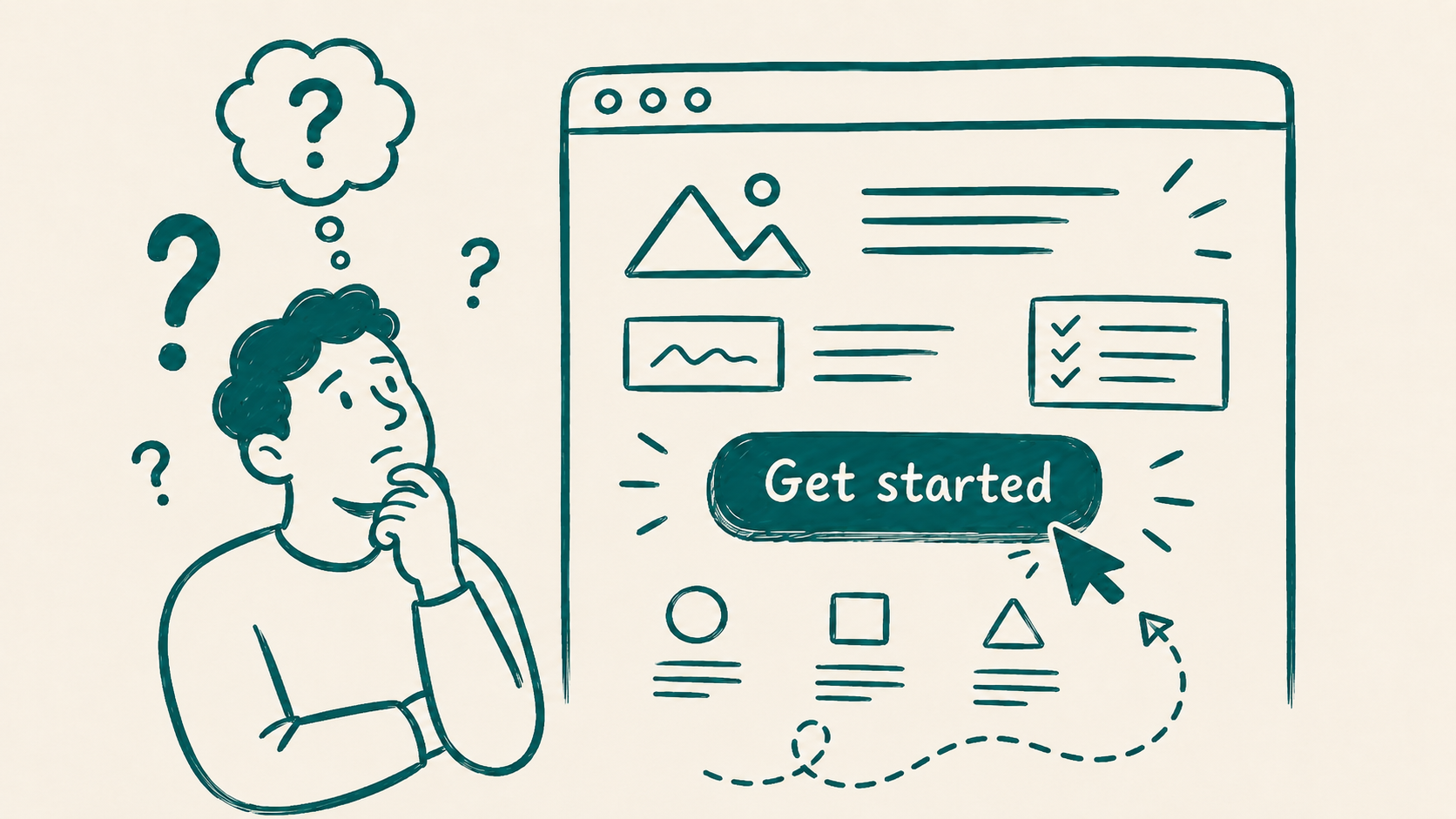
"Get Started" appears on roughly 8 in 10 landing pages I audit.
At this point it feels less like copy and more like a default Figma component that never got a real name. Three words that shipped because nobody could think of something better.
The problem is conversion damage. Quiet damage. The kind that's easy to miss because the page still looks fine and the button still gets some clicks.
What "Get Started" is actually communicating
From the visitor's side, clicking "Get Started" means agreeing to something unknown.
Started what? A credit card form? A 14-question onboarding flow? A free trial that auto-renews? A 30-minute sales call? The button doesn't say. So the visitor has to guess. And people who have to guess usually don't click.
This is a micro-anxiety problem. Every CTA click is a small commitment. The visitor is weighing what they're about to agree to against how much they want what you're offering. Vague copy makes the commitment feel bigger than it is. The friction is invisible, but it's real.
I've audited enough landing pages to see the pattern: pages with specific CTA copy consistently outperform pages with identical designs and generic copy. The button text is doing work that most designers never think about.
The clarity test every CTA needs to pass
Read the button. Do you know what happens immediately after you click it?
"Create your account" passes. "Book a 30-minute demo" passes. "Start your 14-day trial" passes. "Get your free audit" passes.
"Get Started" fails. "Learn More" fails. "Sign Up" barely passes — you know you're creating an account, but you know nothing about cost or commitment.
The best CTA copy is a description of the next screen. One specific thing. The visitor reads it and knows exactly what they're agreeing to. Everything before the button is conversion work. The button seals it or loses it.
Notion used "Get Notion free" for years. Not perfect copy, but notice what it does: names the product and names the cost. Two pieces of information "Get Started" never gives.
Stripe says "Create account" on their primary sign-up CTA. Specific. Tells you what the next screen is. No ambiguity.
Both of those are better than "Get Started," and neither required a copywriter.
3 jobs every CTA has to do
Most SaaS CTAs do one of these. The good ones do all three.
Tell the visitor what happens immediately after the click. "Book a demo" means a calendar. "Create account" means a form. "Start trial" means product access. That clarity removes the hesitation. The visitor doesn't have to imagine the next step — they already know it.
Name the cost or the commitment level. "Free" is the single most conversion-positive word you can add to a CTA if it's true. "14-day," "no credit card," "cancel anytime" do the same job. They shrink the perceived commitment. The visitor decides to click because the cost feels manageable.
Match where the visitor is in their decision-making. A visitor who just landed on your page for the first time shouldn't hit "Start your free trial." They're not ready to decide anything. "See how it works" or "Watch a 3-minute demo" matches their awareness level. Lower ask. Higher conversion rate on cold traffic.
The mismatch between CTA and visitor awareness is the most common mistake I see. The copy isn't always the only problem. But it's the cheapest fix.
The awareness-to-ask match
Visitors don't all arrive at the same point in their thinking. Someone referred by a client who worked with you is ready for "Book a call." Someone who found you through a search is not. Showing them the same CTA loses the cold visitor and under-serves the warm one.
A landing page has 2 CTA jobs, and they need different copy.
The primary CTA should match the average visitor's awareness. If most of your traffic is cold, that CTA needs to be low-commitment. "Try it free," "Book a demo," "See how it works." Something that lets them engage before committing to anything significant.
The secondary CTA is for visitors who aren't ready for the primary ask. "Read how it works." "See a walkthrough." "Check the case studies." They're staying but they need more before they'll click the main button. Give them a next step anyway.
Most pages have one CTA and zero awareness calibration. That's a missed conversion for every visitor who wanted to engage but wasn't quite ready.
On first-person CTA copy
CRO practitioners have tested first-person button copy for years. "Start my free trial" vs "Start your free trial." From what's been published, the first-person version wins more often than not.
The reasoning holds up: first-person framing puts the visitor in the mental state of completing the action. "Start my free trial" is the visitor committing to something in their own head. "Start your free trial" is the brand telling them to do it. One feels like a decision. The other feels like an instruction.
I haven't run controlled tests myself, but I take it seriously when I audit. Worth testing on any high-traffic CTA before assuming either direction is right for your audience.
One question to ask before any CTA ships
Cover everything else on the page. Read only the button text. Do you know what you're agreeing to?
If yes, ship it. If no, rewrite it before you touch anything else on the page.
CTA copy takes 30 minutes to think through properly. Most founders spend 30 minutes picking button color. The color is not the conversion variable here.
If your FAQ section has a question about what happens after you click the CTA, your button copy failed. Fix the button, not the FAQ.
Any statistics cited in this post come from third‑party studies and industry reports conducted under their own methodologies. They are intended to be directional, not guarantees of performance. Real outcomes will depend on your specific market and execution.
Is "Get Started" ever the right CTA copy?
Rarely, and only if the brand is well-known enough that the product explains itself before the visitor hits the page. Figma can use "Get Started" because designers already know what Figma is before they land. For an early-stage product nobody's heard of, the copy has to do more work. "Get Started" at that stage is a conversion liability. The bigger the awareness gap, the more specific the CTA needs to be.
Should the primary and secondary CTA use different copy?
Yes, and they should ask for different levels of commitment. The primary CTA is your highest-value conversion action: "Start your trial," "Book a demo," "Create your account." The secondary CTA gives visitors who aren't ready a smaller next step: "See how it works," "Read a case study," "Watch the walkthrough." Two CTAs with the same commitment level give the visitor no way to self-select, and you lose the person who wanted a lower-friction option.
How long should CTA copy be?
As short as it can be while still passing the clarity test. "Book a demo" is 3 words and passes. "Start your 14-day free trial" is 6 words and passes. "Start your 14-day free trial, no credit card required" starts to clutter the button. The credit card qualifier often works better as fine print directly below the CTA than inside the button itself. The button copy is the action. The qualifier is the reassurance. Keep them separate.
Does first-person CTA copy actually convert better?
In most published tests, yes. The mechanism seems to be that first-person framing ("Start my free trial") puts the visitor in the mental state of completing the action rather than being told to. That said, audience differences matter. Run an A/B test on any CTA getting significant traffic before assuming the direction that worked on someone else's page will work on yours. The principle holds up, but your specific numbers are the only truth.
How do I choose a CTA if I have multiple types of visitors?
Pick the CTA that converts your most valuable visitor type, not the median visitor. Then add a secondary CTA for the others. If your best customers come in through demo requests, the primary CTA is "Book a demo." If you also get self-serve signups who'd never schedule a call, "Try it free" is the secondary. Visual hierarchy matters as much as copy here: the primary CTA gets the weight. The secondary gets a text link or a ghost button. Two equally prominent CTAs competing for the same click cancel each other out.