
AI builders now make more websites than designers ever will: Lovable alone reported more than 100,000 new projects a day in December 2025. The research on those sites points the same way. They ship fast, they look alike, they leak data more often than founders expect, and visitors still judge them on design within 50 milliseconds.
I design and build marketing sites for founders whose site was vibe-coded or self-built, so I went looking for the numbers behind what I see in audits. These are the 25 figures that held up, each linked to the organization that collected it, as of November 2026.
The numbers at a glance
The research on AI-built websites falls into five questions. This table has the headline figure for each.
| Question | Headline figure | Source |
|---|---|---|
| How many sites are AI-built | About 200,000 new Lovable projects on a typical day in early 2026 | Lovable, via TechCrunch |
| Do developers trust AI output | 32.7% trust its accuracy, 45.7% distrust it | Stack Overflow 2025 |
| Are vibe-coded apps secure | 170 of 1,645 Lovable apps scanned had exposed databases | Matt Palmer, 2025 |
| Do AI designs look alike | Creative range of 0.581 for AI models against 0.902 for human designers | Design Creativity Bench, 2026 |
| Can AI search read them | None of the major AI crawlers run JavaScript | Vercel and MERJ, 2024 |
How many websites are built with AI
AI builders produce websites at a volume no design industry has seen. The figures below are vendor numbers, reported by the companies themselves, so read them as the top of the range.
- Lovable reported more than 100,000 new projects a day and 25 million projects in its first year, plus 500 million visits to Lovable-built sites in 6 months, in its December 2025 Series B post.
- By March 2026 Lovable told TechCrunch it saw about 200,000 projects on a typical day, with a peak above 500,000 on March 8, about 8 million users and more than $400 million in annual recurring revenue, with 146 full-time staff.
- Cursor, the AI code editor many founders use to build their own sites, passed $1 billion in annualized revenue, according to its November 2025 Series D announcement.
Put those together and a seed-stage founder in 2026 is competing for attention against millions of sites made with the same handful of tools.
Developers use AI but don't trust its output
Developers have adopted AI tools almost completely and trust the output less than half the time. The Stack Overflow Developer Survey 2025, with more than 49,000 respondents, found:
- 84% use or plan to use AI tools, up from 76% in 2024.
- 47.1% use them every day, and 50.6% of professional developers do.
- Only 32.7% trust the accuracy of AI output, while 45.7% distrust it.
- 66% say they spend more time fixing AI code that's almost right, and 45% call that their top frustration, per Stack Overflow's write-up.
- 77.5% say vibe coding isn't part of their professional work: 72.2% answered no and 5.3% answered "no, emphatically".
That last number matters for founders. The people who build software for a living mostly keep vibe coding out of their own production work.
Designers like AI less than developers do
Designers are measurably less happy with AI tools than developers. Figma's 2025 AI report, a survey of 2,500 Figma users, found 82% of developers satisfied with AI tools against 69% of designers. Asked whether AI improves the quality of their work, 68% of developers said yes against 54% of designers.
My read: AI is good at producing something that works and weaker at producing something that's right for one specific buyer, and designers are the ones paid to notice the difference. I covered what that means for design jobs in the data on whether AI will replace designers.
How secure vibe-coded apps are
Vibe-coded apps leak data often enough that security researchers now scan them in bulk. Three of the four sources below sell security scanning, so they have a reason to find problems. The findings are still specific and repeatable.
- In March 2025, researcher Matt Palmer scanned 1,645 Lovable apps and found 170, or 10.3%, with exposed databases across 303 endpoints, leaking emails, phone numbers, API keys and payment details. It became CVE-2025-48757.
- Wiz Research found that 1 in 5 organizations building on vibe-coding platforms were exposed to risk, in September 2025.
- Escape.tech scanned more than 5,600 public vibe-coded apps in October 2025, about 4,000 of them on Lovable, and found more than 2,000 vulnerabilities, more than 400 exposed secrets and 175 cases of exposed personal data, including medical records and bank details.
- In February 2026 The Register reported one Lovable-hosted app with 16 vulnerabilities, 6 critical, exposing 18,697 user records. Lovable said the vulnerable database wasn't hosted by Lovable.
The builders are responding. Lovable added a security review before publishing in November 2026. But a marketing site rarely needs a database at all, and a database that isn't there can't leak.
Do AI-generated designs look the same
AI-generated designs are measurably more alike than human ones. Design Creativity Bench, an October 2026 study, scored creative range at 0.581 across AI models against 0.902 for human designers. Designs from different models given the same prompt scored 0.592 on originality against each other, compared with 0.764 between a human design and a model's.
Two more studies back it up without a single headline number:
- A July 2026 study of 120 interfaces built by 5 UI agents across 24 tasks found the tools converged on the same visual appearance and layouts. Color was the only thing that varied much.
- A March 2026 paper on web vibe coding argues that generating a site with no friction makes design homogenization worse.
No study I found counts how often AI tools reach for Inter or a purple gradient, so I won't quote a number for it. The benchmark says the same thing in a more careful way: your vibe-coded site has a thousand twins.
Can AI search read a vibe-coded site
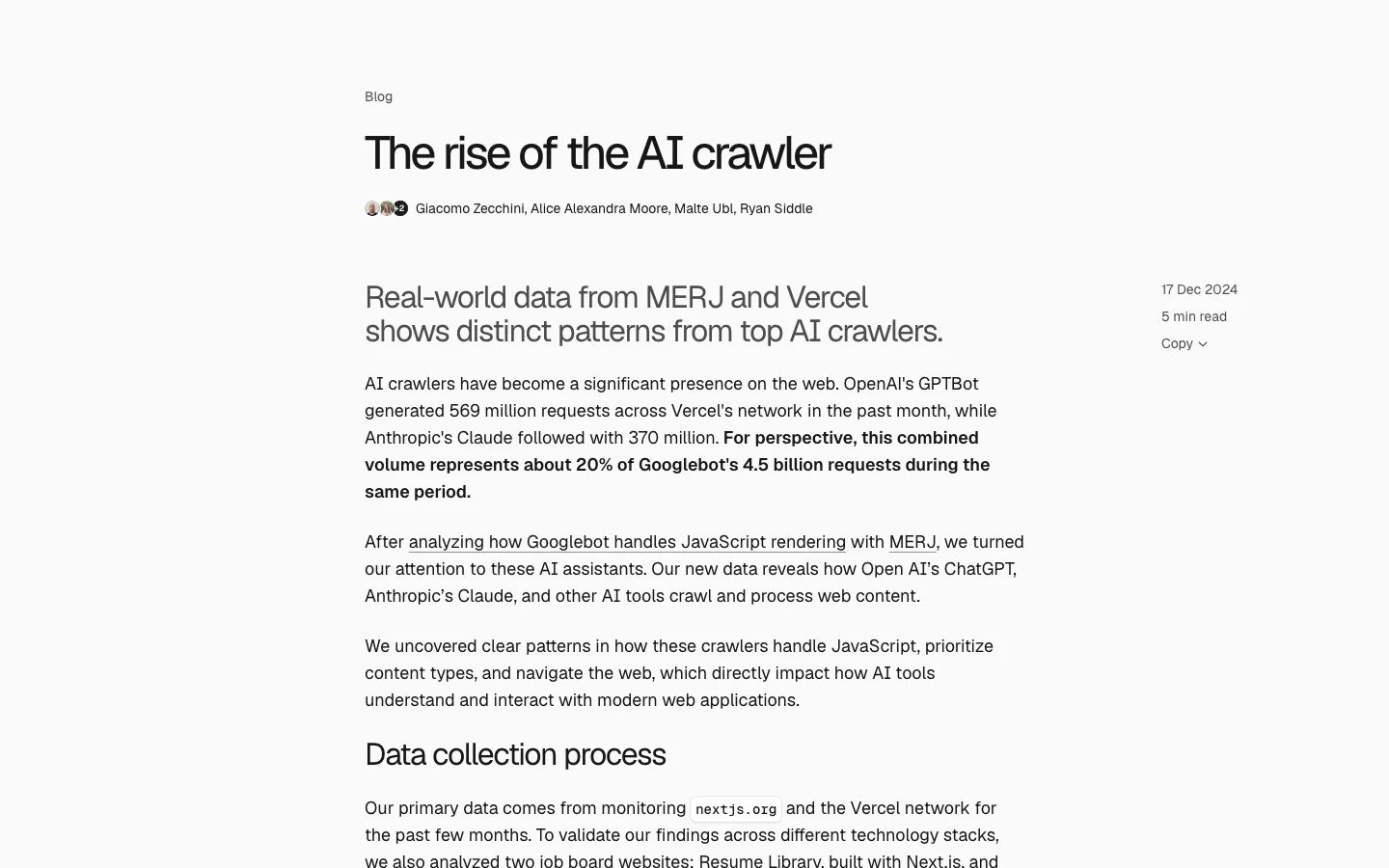
AI search engines can't read a page that only exists after JavaScript runs. Vercel and MERJ's December 2024 study found that none of the major AI crawlers, including GPTBot, ClaudeBot and PerplexityBot, render JavaScript. They download script files without running them: 11.5% of ChatGPT's crawler requests and 23.84% of Claude's were JavaScript files.
The same study counted 569 million GPTBot fetches and 370 million from Claude in a month, together about 20% of Googlebot's 4.5 billion. The AI crawlers hit 404 pages about 34% of the time, against 8.22% for Googlebot.
This used to be a real problem for Lovable sites, which rendered in the browser. Lovable's docs now say apps created from May 13, 2026 render on the server, and older apps serve pre-rendered pages to verified crawlers. If your site predates that, check what a crawler sees. I ran that check on my own Webflow site in an AI search audit of humbldesign.io.
Speed is a separate gap, and it's not unique to AI builders. The HTTP Archive Web Almanac 2025 found only 48% of mobile sites and 56% of desktop sites pass Core Web Vitals. On mobile, 62% pass on Largest Contentful Paint, the metric a heavy hero image breaks.
Why design still decides trust
Visitors decide whether to trust a site in a fraction of a second, and they decide on design. A 2006 Carleton University study by Lindgaard and colleagues found people form a judgment of a site's visual appeal in 50 milliseconds, and it matches what they think after looking longer. In Stanford's web credibility research with 2,684 participants, 46.1% of comments about why a site was or wasn't credible mentioned its design look, per the study's press release.
AI makes that judgment harsher. In a 2026 survey of 1,008 US consumers by Propeller Insights for Kinsta, 58% said they trust content less when they think it's AI-generated. And 44.7% said they always or mostly visit the company's website after an AI assistant recommends it, so the site is where the AI's recommendation gets checked.
What the numbers mean for a founder
The numbers say a vibe-coded site is a fine way to launch and a weak way to look credible. Millions of sites come out of the same few tools, the designs converge, and the visitor makes up their mind in 50 milliseconds, often after an AI assistant sent them there.
So the build is cheap now and the design is what separates you. Keep the speed of the AI builder for the product. Give the marketing site a design pass by a person, get any database you don't need off the public internet, and check what crawlers see. My list of the 10 things I check first is in the mistakes I see on AI-built landing pages.
The figure I'd tape above my desk is 0.581. That's how much range AI design has, measured against 0.902 for people.
Sources
Lovable, Series B announcement, December 2025: lovable.dev/blog/series-b
TechCrunch, Lovable revenue and usage, March 11, 2026: techcrunch.com
Cursor, Series D, November 13, 2025: cursor.com/blog/series-d
Stack Overflow Developer Survey 2025, AI section: survey.stackoverflow.co/2025/ai
Figma, 2025 AI report, April 24, 2025: figma.com/blog
Matt Palmer, statement on CVE-2025-48757, May 29, 2025: mattpalmer.io
Wiz Research, common security risks in vibe-coded apps, September 18, 2025: wiz.io
Escape.tech, vulnerabilities in vibe-coded apps, October 29, 2025: escape.tech
The Register, Lovable app vulnerabilities, February 27, 2026: theregister.com
Rusia et al., Design Creativity Bench, arXiv, October 8, 2026: arxiv.org/abs/2610.11539
Imteyaz et al., Design Theater, arXiv, July 2026: arxiv.org/abs/2607.22928
Shin et al., design homogenization in web vibe coding, arXiv, March 13, 2026: arxiv.org/abs/2603.13036
Vercel and MERJ, the rise of the AI crawler, December 17, 2024: vercel.com/blog
HTTP Archive, Web Almanac 2025, Performance: almanac.httparchive.org
Lindgaard et al., Behaviour and Information Technology 25(2), 2006: doi.org
Kinsta and Propeller Insights, AI discovery and trust survey, 2026: kinsta.com
Any statistics cited in this post come from third‑party studies and industry reports conducted under their own methodologies. They are intended to be directional, not guarantees of performance. Real outcomes will depend on your specific market and execution.

How many websites are built with AI?
No one publishes a total, but the vendor numbers are huge. Lovable reported more than 100,000 new projects a day in December 2025 and about 200,000 on a typical day by March 2026, with a peak above 500,000. Cursor passed $1 billion in annualized revenue in November 2025.
Are vibe-coded websites secure?
Many vibe-coded apps aren't. A 2025 scan found exposed databases in 170 of 1,645 Lovable apps, and Escape.tech found more than 2,000 vulnerabilities and 400 exposed secrets across 5,600 vibe-coded apps. A marketing site with no database avoids most of this, so check what your site connects to.
Do AI-generated website designs all look the same?
AI-generated designs are measurably more alike than human ones. The October 2026 Design Creativity Bench scored AI models at 0.581 on creative range against 0.902 for human designers, and a July 2026 study of 120 interfaces from 5 UI agents found they converged on the same look and layouts.
Can ChatGPT and Claude read my vibe-coded site?
ChatGPT's and Claude's crawlers don't run JavaScript, per Vercel and MERJ's 2024 study, so a page that only renders in the browser looks empty to them. Lovable apps created from May 13, 2026 render on the server, and older ones serve pre-rendered pages to verified crawlers.
How fast do visitors judge a website?
Visitors judge a website's visual appeal in about 50 milliseconds, according to a 2006 Carleton University study by Lindgaard and colleagues, and that first judgment matches what they think after looking longer. Design is the first thing a visitor uses to decide whether to trust you.